Designing Rolls-Royce Provenance
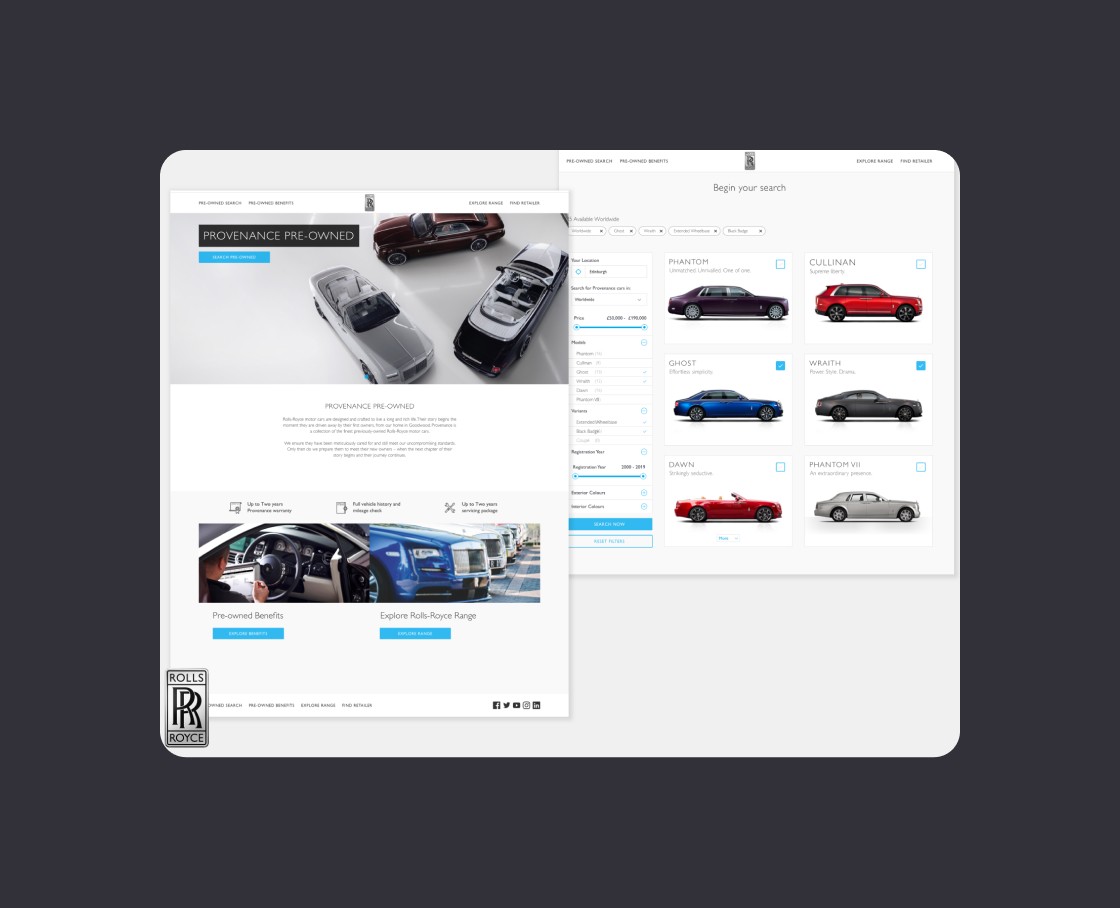
Rolls-Royce asked us to build a platform where buyers worldwide could browse pre-owned stock, explore vehicles in detail, and contact dealers. The real challenge was holding luxury and usability together an experience that felt like the brand at every point and still got people to the enquiry form without friction.
Outcomes
20% reduction in drop-off on the search results page after simplifying filters and list interactions.
Higher engagement as users explored detailed imagery and specifications.
Improved discovery through cleaner navigation and filtering.
The challenge
Rolls-Royce wanted a dedicated pre-owned platform that let buyers worldwide browse available stock, explore individual vehicles and contact dealers without losing the sense of craft and prestige the brand demands at every touchpoint.
That's a harder design problem than it sounds. Luxury and utility can pull against each other. A search filter that prioritises speed and clarity can feel off brand. A layout that prioritises atmosphere can bury the actions a buyer actually needs. The brief was to hold both an experience that feels unmistakably Rolls-Royce and works without friction.
My role
I led the UX design from discovery through launch and into post-launch optimisation. I worked with connect-auto's product team and Rolls-Royce's own stakeholders throughout, covering research, information architecture, interaction design and prototyping. After launch I stayed close to analytics and user behaviour to identify and prioritise usability improvements.
Understanding the brand before touching the interface
Before sketching anything, I spent time at Rolls-Royce's Goodwood factory. Understanding how the cars are made, the materials, the craftsmanship, the provenance of every detail was essential context for making design decisions. A Rolls-Royce buyer purchasing a pre-owned car is buying a continuation of that story. The platform needed to communicate it.
This changed how I thought about the vehicle detail page. The provenance section, the verified history, the photography, these weren't supporting details to surface below the fold. They were the substance of the product.
Research: what buyers and dealers actually needed
I ran remote interviews with potential buyers and studied heatmap and session recording data to understand how people actually behaved on the existing experience. A few findings shaped everything that followed:
80% of users interacted with the image carousel. The gallery was where buyers spent the most time, and it needed to be fast, prominent and visually excellent.
Only 18% scrolled below the fold. Key information like specifications, provenance, calls to action had to appear early. Content buried lower in the page was largely invisible.
Enquiry completion was at 2%. That number pointed directly to friction: a form that asked too much, a process that wasn't clear and CTAs that disappeared as users scrolled.
I also ran workshops with dealers to map their enquiry flows and understand what constituted a qualified lead. Designing the enquiry experience without understanding what dealers needed from it would have optimised the wrong thing.
Rethinking the information architecture
The existing sitemap and filter taxonomy had accumulated complexity without purpose. I restructured both from the buyer's perspective: what do people need to narrow down a choice and in what order?
The filter set was rationalised to the variables that actually influenced decisions model, year, mileage, price and provenance status. Empty states and quick resets were built in so that no search left a buyer stranded. The vehicle specification hierarchy was reordered to surface the details buyers reached for first, and to hold the provenance story at an appropriate level of prominence without overwhelming the page.
Designing the vehicle detail page
The vehicle detail page was the most important screen. This is where a buyer decides whether to enquire, and where the trust signals works.
I structured it around three priorities. First, imagery and provenance upfront, the gallery prominent and accessible, the verified history visible without scrolling. Second, a specification layout that presented the right level of detail for a buyer who knows what they're looking for without intimidating someone who doesn't. Third, calls to action that stayed visible throughout the page, enquire, request a callback, find a dealer, so no matter where a buyer was in their reading, the next step was obvious.
Dealer credentials, warranty information, and multipoint inspection records were placed to reinforce trust at the moment of decision, not tucked away in a corner.
Optimising the enquiry flow
The 2% enquiry completion rate was a clear signal. I shortened the enquiry form to the minimum required for a dealer to respond usefully, clarified what happened after submission, and made the alternative contact routes, callback request, dealer finder equally visible. The result was a process that felt proportionate to the act of enquiring about a luxury car: significant but not burdensome.
Constraints I navigated
Brand guidelines
Rolls-Royce's visual standards are detailed and non-negotiable. Every design decision had to preserve the luxury feel while improving clarity and accessibility. This required close collaboration with the brand team and a willingness to find solutions that satisfied both requirements rather than trading one off against the other.
CMS and data limits across markets
The platform served multiple markets with different inventory structures and regional rules. I designed components that worked within existing data architectures rather than requiring new infrastructure, which kept the project feasible and kept the development scope manageable.
Development efficiency
Where possible I re-skinned and extended existing UI components rather than building from scratch. This reduced development effort and kept the delivery timeline realistic without compromising the quality of the output.
Impact
After launch, simplifying the search results filters and list interactions produced a 20% reduction in drop-off at that stage of the journey. Engagement with vehicle detail pages increased as buyers spent more time exploring imagery and specifications. Enquiry rates improved as the friction in the contact flow was removed.
The post-launch optimisation work, monitoring analytics, identifying where behaviour diverged from expectation, and making targeted improvements was as important as the initial design. The product shipped in a better state than it launched and continued to improve.
What I learned
Designing for a luxury brand taught me something that applies to every product context: understanding what a brand means to its customers is as important as understanding what they need to do. A Rolls-Royce buyer isn't just purchasing a car. They're purchasing a version of themselves. The platform needed to reflect that through the quality of every decision about what to show, in what order and with what level of care.
The data also taught me to look past the obvious optimisation targets. A 2% enquiry rate looks like a form problem but it was also a trust and CTA placement problem.